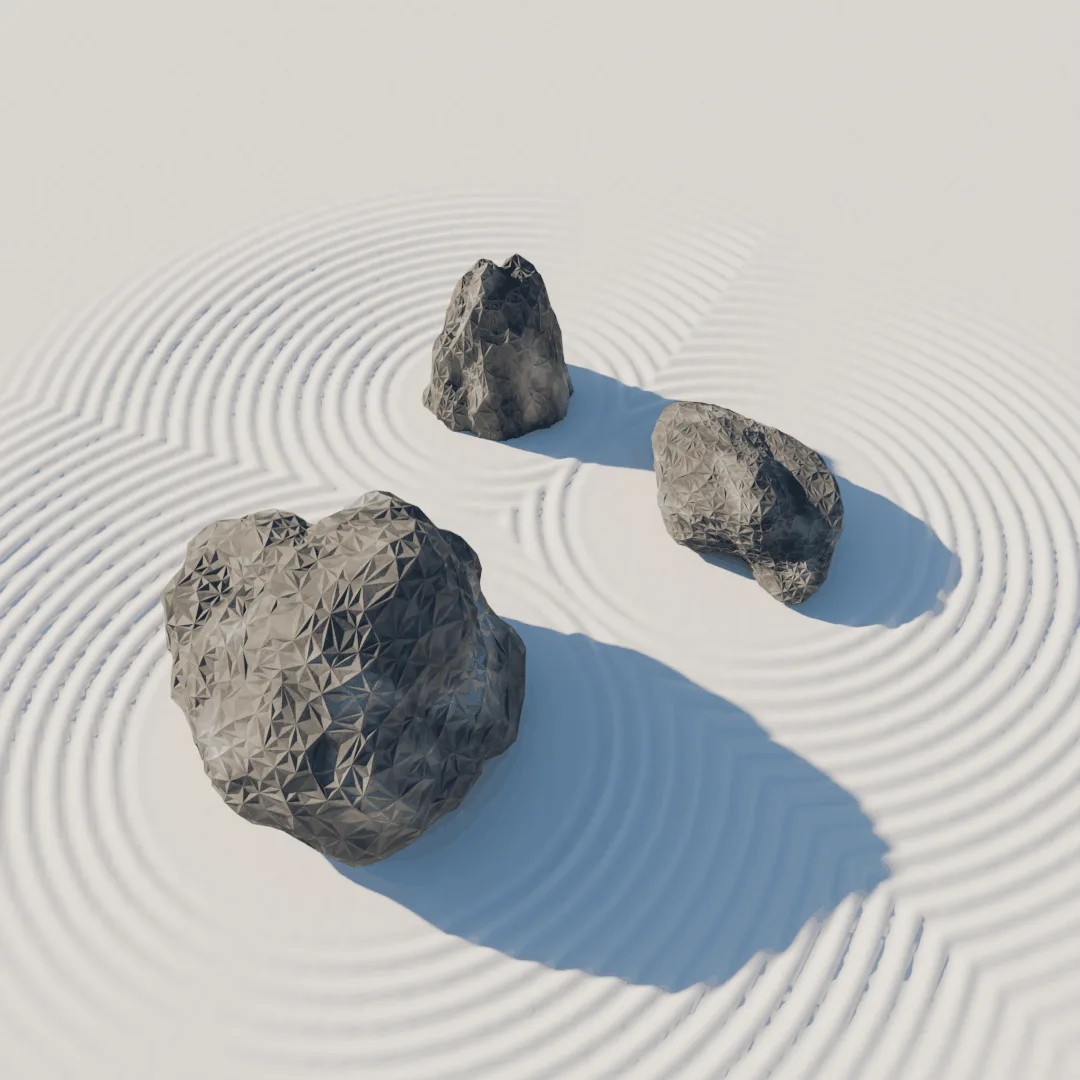
The stones start from a coarse convex hull and are refined through subdivision, noise displacement, and a light Voronoi fracture pass on the shadow side. A single parameter drives the tessellation density across the loop, so the three rocks stay in sync while reading as distinct forms. The sand pattern is not raked by hand; it is a distance field around the base of each stone, thresholded into rings and offset to give the drag of a rake. The composition itself follows the traditional asymmetric triad: a heavy foreground stone, a taller middle stone, and a low third stone that keeps the eye from settling.
The point is not the render. It is that the same rules produce every frame: the density curve, the ring spacing, the placement grammar. Tessellation as mesh operation and tessellation as ground pattern are the same idea worked at two scales, which is what made the piece worth finishing rather than tuning forever.